Dr. Winter’s Thoughts About Mission Education

Dr. Ralph Winter wrote an “Executive Summary” in 2002 that is focused on the state of mission education. He begins by explaining that for ten years, the U.S. Center for World Mission has been involved in one of the most extensive projects that has been tough to work on, and that is rewriting, enriching and restructuring the whole college and seminary curriculum. He poses the question of why a mission center would undertake this sort of project? The answer he offers is that “the university tradition that now blankets the earth tears into tiny course-sized fragments the reality of God and His Creation and even the human story.” These fragments prevent the average believer from ever seeing the complete picture. So Winter and his staff have felt that there are numerous reasons for putting the picture back together and making sure the result reflects properly the Biblical emphasis upon God and His mission to the world. While Winter is excited about the 50,000 students who have gone through the Perspectives Study Program by this year, a single course is only a drop in the bucket compared to what ought to be done. He is tired of trying to add to, patch up and reintegrate existing college and seminary courses. What needs to be done could not be accomplished by just adding another course like Perspectives. So Winter and his team decide to invade the mainstream curriculum of the liberal arts with proper content and perspective as they see it, teaching everything traditional to college and seminary (except for vocational specialties) and doing so with a broad global mission perspective that encompasses 4,000 years.

Yet one small university like William Carey International University in Pasadena, CA could do very little to impact the many students daily emerging from other schools. What benefit would be there to one specialized university offering a new mix of basic education, Winter asks. It could only be achieved in partnership with other schools. The idea is to sell this new boldly rebuilt curriculum to Christian colleges in hopes that they will enroll a large numbers of students. Winter writes, “Early on we received the unexpected request from Wycliffe’s new Language Survey department to employ a modified version of our graduate curriculum for those mission candidates who have only two years of college.” Since the material Winter’s people have prepared has linguistics and cultural anthropology as strong subjects which seminary curricula leave out, this connection with Wycliffe seems like an ideal bridge to a college degree for said candidates, and even more if they complete their study on the field! So the “Degree Completion” program has been instated at the time of this writing and Winter is enthusiastic about it impacting not only Wycliffe but other mission agencies too. It provides opportunities for thousands of mission-minded believers in their late 20s and early 30s who work in local churches for a mission cause but are hindered by not having a college degree, nor the solid knowledge that would enable them to be missionaries or mission mobilizers at a higher level.

Winter has to wonder if enough Christian colleges will take up the new curriculum and really make a difference to the mission world? How will this type of study program be available to field missionaries, Third World missionaries and national pastors? Winter says, “Could this also substitute for seminary in many fields where very few pastors have adequate training of any kind?” Could it be abridged for first-year college students? Yes, what this all means is that striking new, incredible events can now be talked through and are in the offing. Winter is glad that various mission leaders and executives he knows of are joining the discussions about this World Christian Foundations study program. Praise be to God!

PSP Reader

Ralph Winter’s Guatemala Years

On Saturday morning, January 9, 1965, the Los Angeles Times had an article with the title “Factories for Guatemala Sought by Missionary” with the subtitle “Minister Praises Climate in Highlands, Describes Rural Work Among Indians.” The writer introduces Dr. Ralph Winter by quoting him saying the highlands of Guatemala has the best labor market north of the equator. Winter is identified as an anthropologist, linguist and ordained United Presbyterian minister who has worked in Guatemala for eight years after his one year in Costa Rica. He tells his interviewer, “…there is an industrialists’ gold mine in Guatemala in low-pay, high-quality labor.” Winter goes on to mention the weather, claiming that it is just as perfect at an 8,000 foot elevation in the mountains as it is in Southern California, where he was born and raised. At the time this article was written, the Winters were visiting his parents, Hugo and Hazel Winter, in South Pasadena for the holidays, having arrived after 80 hours of driving from Guatemala in the family’s station wagon. Winter, an alumnus of Caltech with an engineering degree, shares that for time and financial reasons, the family drives straight through with two drivers taking turns, one driving while the other sleeps. Amazingly, the road is black-topped all the way from Quetzaltenango, Guatemala to South Pasadena! Next, the writer reviews Winter’s educational background: studies at Princeton and Fuller Theological Seminaries, the universities of Michigan and Oklahoma and a doctorate in linguistics at Cornell University. In 1956, the former Board of Foreign Missions of the Presbyterian Church (U.S.A.) appointed him to Guatemala, “but with the disfavor attached to the word ‘missionary’ in some foreign countries, he is now listed as a ‘fraternal worker’ with much of his time spent among the Mam Indians.”

The Mam Indians are a tribe of 250,000 members and are descended from the Mayans. They already had their language reduced to writing and had a New Testament in their language for a long time by the time the Winters arrived. Yet the Winters work equally with Guatemalans of both European and Indian descent. The programs they established are open to anyone interested. Their area of the mountains is brisk, hilly and dry, therefore limiting agriculture and making industrialization the only feasible way forward. So the Winters have actively pushed for it in the last five years. Factories were set up in the region to test the Indians’ aptitude for the work, and the results were pleasing. “The only real difficulty they have is the bias against them—because they are Indians—when they go to the capital to sell things,” Winter states. The Winters on many occasions have had to be intermediaries between productive Indians and the market place they face. One policy that has been set up is for an Indian working in a factory to retain his hold on a piece of land, even the smallest parcels, and Winter is proud of this fact in the lives of the Indians. So the factory workers increase their income with labor. Winter admires these people for being independent, practical, very different from other Latin Americans, and pragmatic when solving life’s problems. He strives to engage in gospel work as he engages in rural development work. The National Presbyterian Church of Guatemala has 15,000 committed members in a population of 3.5 million. But 60,000 have access to Presbyterian churches in their locations.

The Winters have a variety of areas they are focusing on while working in their rural region. These include helping to establish public schools that are funded privately, medical work due to Mrs. Winter being a registered nurse, running small plants, and establishing credit unions. Winter indicates that of course their goal is to plant churches as well. The writer quotes him, “We find that the most important thing is to gather people together weekly and renew and reinforce their hopes and aspirations. We feel that the church network provides a solid background for our other activities.” One result Winter hopes for from the partial industrialization of the mountain country is that progressive Indians will stay in the highlands where they would rather live. He thinks that progressive people emigrating in search of work badly affects society as a whole. The article concludes with the announcement that Dr. Winter will only speak publicly once while in Southern California on Sunday evening at Bel Air Presbyterian Church.

OLYMPUS DIGITAL CAMERA

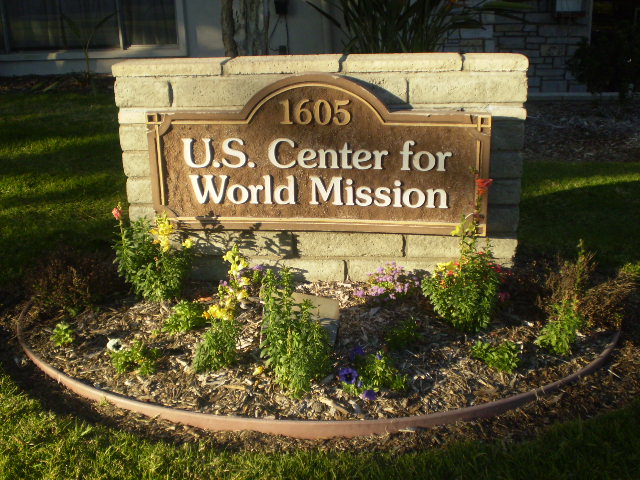
This Is What The U.S. Center Is All About

There was an article in Christianity Today on January 21, 1983 entitled “Ralph Winter’s Mission Center Forges Ahead; Money Still Tight,” and the subtitle is “His ‘unreached people’ strategy seems to be taking hold among other missions.” Dr. Winter founded the U.S. Center for World Mission to focus on two primary activities: locating and determining how to reach the world’s hidden [or unreached] peoples and mobilizing Christians through information about them. This article discusses how Dr. Winter’s goal at the U.S. Center for World Mission was not only to raise funds for the purchase of the campus available to him and his staff in Pasadena, but to mobilize believers in churches all over the country to become excited about frontier missions and act to make a difference therein, the options being praying, giving and even going. His awareness raising reached churches and mission agencies alike. One bullet point example says, “Among denominations, the Evangelical Free church recently named a staff person to work full-time promoting frontier missions in its local churches. The International Church of the Foursquare Gospel has set a goal of contacting 100 unreached people groups by 1990.”

The U.S. Center additionally initiated the Frontier Fellowship, a group encouraging mission agencies and denominations to a daily prayer and giving discipline, hoping to involve one million people by the end of 1983. If each person were to give daily loose change to frontier missions, and the author figures this to amount to 28 cents per individual, the plan would produce $100 per year per person, meaning $100 million each year. Donors are requested to designate $15 for the U.S. Center, which would take care of the $10 million owed on the campus at this point. The remainder would be for frontier missions programs of the various agencies. The Frontier Fellowship began publishing a Daily Prayer Guide at this time, which had 20,000 subscribers, and fifteen organizations were part of this fellowship, a few being the Africa Inland Mission, the World Evangelical Fellowship and a United Presbyterian group.

Dr. Winter promoted a lifestyle he called the “wartime lifestyle” that emphasized saving money and living frugally when possible. The U.S. Center relied heavily on volunteer workers, including Dr. Winter’s father Hugo Winter, a retired engineer who volunteered one day per week. The author writes, “Staff receive missionary salaries based on need, so that Winter receives no more than the newest staff member. He’s usually seen wearing the same blue sport coat and driving to work in a 1965 station wagon on its third 100,000-mile cycle.” Winter’s original plan to pay for the campus was to raise the $15 million through one million gifts of $15 each. This would involve a large number of people in frontier missions while not diverting money away from churches and other mission agencies. However, Winter ended up needing to give in to receiving large gifts from individuals and organizations to save the campus from foreclosure. Yet he was committed to reassigning gifts over $15 to other agencies, and sizeable gifts from churches and organizations were to be paid back as soon as enough gifts of $15 a piece came in as a result of the Frontier Fellowship plan.

OLYMPUS DIGITAL CAMERA

Birthdays Unite the Family!

Dr. Ralph Winter wrote a letter to all of his daughters, sons-in-law, and grandchildren on November 21, 1994. In one portion of it, he is discussing ways to stay connected as a family across the distances where each family lives. He says he recently prepared a table of all of the birthdays of the family members. He writes, “I did not do this to remind people to send gifts, but to enable people to acknowledge milestones. And, I certainly did not notice until this moment that my own birthday is the next this year. I’ll be 70.” The family had communicated an idea of exchanging video clips with each other, but Dr. Winter laments that this is not working out very well in spite of all of the equipment available then. He wonders if the problem is that a video cassette is usually two hours in length and no one would want a message that lasts that long. Another problem he proposes is that certain occasions for filming video footage are absent in the families’ lives.

Dr. Winter’s idea is for birthdays to be the times that prompt taking video footage of the whole family, of course including the birthday honoree. He mentions that maybe the rest of the families can sit down and send birthday greetings to the person on [cassette] tape, “each member of the family saying something nice about the one having the birthday. That [way] we would gradually [rack] up a fairly consistent logging of the growth of each individual in a family.” Even better, the family with the birthday person should film a video clip including the honoree saying something historic on his or her birthday, and the other families might film a video of each member saying something nice to the one celebrating. As the children grow, Winter believes this kind of birthday greeting will become more meaningful and insightful to them. He states that it does not take much imagination to reflect on how significant a birthday person would find even a 30-second greeting from 21 people who are all related to him or her!

If each family patched together the annual “statements” of the birthday honorees, what an amazing picture that would be according to Winter of how the person has grown, to be seen years later even by the next generation. Since birthdays are unavoidable occasions when families are forced by our culture to do something special, why not have video footage as part of the celebration, Winter wonders. And if every family films a video of each member saying something nice to the birthday person, then that person will feel like the entire family remembered his or her birthday and celebrated even though they are not physically present. Winter doubts that giving gifts would be as valuable as the “gift” of videos or cassette tapes, but he is not forbidding the giving of gifts either. He wraps up the subject by commenting, “I am not in a position to impose this kind of thing. But I can at least ‘pledge’ myself to lobby for this kind of activity in the corridors of power at 533 Hermosa Street [his house]. At least Roberta and I ought to be able to send greetings to the birthday people on this list I enclose.” He promises to see what he can do for each birthday event.

What Is It With Disease, Anyway?

On the last day of 2002, Dr. Ralph Winter wrote an article entitled “A Growing Awareness about Disease.” It reflects the significant shift in his thinking in the last decade of his life in response to the loss of his wife of almost fifty years Roberta to multiple myeloma. He is fascinated by the disconnect between God’s good creation and the fact of life that all in the animal kingdom (including human beings) live fearful of predators be they other humans or animals of all sizes down to the microscopic level. Winter points out that enormous expenditures go into the medical field all the time, but, he says, “I was surprised to discover that this enormous expense is almost entirely focused on healing the sick not seeking the source of the sickness.” After all, lots of money from patients and insurance companies seems to be available to benefit people in pain and sickness. And people are focused on the present conditions, not thinking about the bigger picture of eradicating diseases for all of humanity. Winter believes it to be ironic that the research universities and government entities are doing along the lines of eradication is funded by pharmaceutical companies! He thinks the FDA is in the business of making money, which is why they charge substantial amounts for their process of approval, and only approve drugs that will be expensive on the market.

Winter, in addition, recognizes the theological implications of all of this. He writes that Christian theology since the fourth century has been informed by neoplatonism in ascribing all evil to God, not Satan. In the books of Job and I Chronicles, reference is made to a significant spiritual Adversary to the work of God. The New Testament equally does “remind us that disease and evil in general are the work of an intelligent evil Adversary.” Winter asks if we will be able to seriously fight disease at its origin if we continue to be unclear about where it comes from. Jonathan Edwards tried to fight smallpox with cowpox vaccine and other pastors did not support him because they thought this act interfered with Divine Providence. Edwards killed himself in the midst of testing vaccines. Then it would not be until two hundred years later that a World Health campaign eliminated smallpox and not in the Name of Christ either.

Winter states, “Our inherited theology allows us to fight ‘terrorists’ that can be seen with the naked eye but not to fight tiny terrorists that can only be seen in a microscope.” He then returns to his area of expertise and ties his reflection to evangelism and mission by acknowledging that there are believers who have lost their faith because of the mystery of evil and suffering. The spectrum is wide when it comes to beliefs, from God allowing evil because of unconfessed sins and Him choosing suffering people to display faith even when in pain to God just being mysterious and God hating sickness and healing all those who believe that He wants to and will. Winter concludes by lamenting that evangelical leaders are not constantly promoting Jesus’ call for His followers to partner with Him to destroy the works of Satan, including disease.

                                                    img20150521_17350898

Dr. Winter Communicates His Concerns

The faculty of Fuller Theological Seminary’s School of World Mission (SWM) were quite a community together when Dr. Ralph Winter was there in the late 1960s and early 1970s. They respected each other for the knowledge each one had and their common goal was to educate students in order that they would participate in the Great Commission after graduation in whatever capacity God called them. These professors’ offices were in a building that was originally a house, and there was a common room in the middle of the offices so that they were bound to see one another in this common room when they were going to and from their offices. They all got together for a meeting at least once a week to discuss SWM matters, and they enjoyed interacting with their students inside and outside of the classroom.

On September 25, 1972, Dr. Winter wrote a note to the SWM faculty about topics that he believed needed to be discussed on Friday, four days later. He mentions a problem he has talked about preliminarily with Arthur Glasser and Alan Tippett and it is that there are numerous books like Tippett’s Bibliography for Cross Cultural Workers, Donald McGavran’s Crucial Issues and Peter Wagner’s Church/Mission Tensions Today which conceivably no class will use extensively because the professor does not require the students to read these texts. Winter says, “If I…knew that the students had these books, I would assign certain chapters as required readings which at the present I am unable to do.” The Evangelical Missions Quarterly bound volumes are another favorite of his. He asks should missiologists not own books with chapters which SWM’s faculty have written? The Church Growth Bulletins promoted by McGavran would also be useful in the classroom. He assures his colleagues he is not only referring to books published by the publishing company Winter started known as William Carey Library.   He just thinks the SWM students ought to leave equipped with a basic missiological library and it is the faculty’s jobs to make sure various books do not slip between the courses.

Dr. Winter also believes the SWM needs a weekly all-school bulletin. He writes, “If…any one of us announces anything in any of our classes that is intended for the whole school[’]s consumption, some of the students and most of the faculty will inevitably miss out, even if it is announced verbally at a convocation of the SWM.” Winter thinks the all-school bulletin would be the solution to any lack of communication within SWM. It does not have to be long—just a one-sided page would suffice most of the time. What does he mean to go in this bulletin? Examples he offers are wives’ meetings, a slide-making camera copying set-up being available, general instructions on term paper formats that apply to all classes, convocation speakers, and joys and concerns for prayer.

                                     The Catalyst at Fuller

Who Should Get The Credit?

On December 17, 2002, Dr. Ralph Winter wrote a short article which he entitled “The Instrumentalities of God,” in which he explores the concept of credit for things that happen in life going always to God when it should actually go to human and angelic beings who are acting on His behalf. He says that the Holy Spirit enables persons to do things we ordinarily would not do on our own not because God needs us but because He has called us and “apparently has chosen to create finite beings who can think, choose, learn, uphold or betray His goals.” What amazes Winter is the fact that these free will agents all live on one planet orbiting the sun that is a tiny spectacle in the vast Milky Way galaxy.

Dr. Winter observes that people often attribute to a dictator in a suffering country all of the horrible occurrences that victimize so many when in reality the leader is not always personally involved but employs others to carry out his plans for him. On rare occasions, a dictator will do something publicly himself to make a point, but his will being in operation does not usually mean he is to be credited personally for whatever happens to damage lives. The same applies to the President of the United States. Many times he is given the credit for actions that his Secretary of State, for example, actually takes.

Dr. Winter asks, “Does God work this way? When an Evangelical is elected to high office we may say ‘God put an Evangelical in the White House,’…even though in fact the Holy Spirit may have moved the hearts of thousands of voters to elect that person.” Winter believes that angels as God’s messengers may do far more than only deliver messages, yet their activities are attributed to God. How about the acts of Satan? Even his doings might be attributed to God, which concerns Winter. Toward the end of his article, he writes “The reason I am pursuing this…is because I am concerned that we not expect God to do things which either angels or men are supposed to do. It would be tragic if we are confused about what He will get done through His unseen instrumentalities and what He expects human beings to do.”

                                              Angels

What Do You Think, Dr. Winter?

There is an article in the newspaper Today’s Christian from February of 1974 that is entitled “May We Have Your Opinion, Ralph Winter?” The question is regarding whether or not the number of Christians in the world is keeping up with the growth in the world population at this time. Dr. Winter is consulted on the matter because he is known as “one of the nation’s foremost historians of Christian missions.” He disagrees with the notion that there will be fewer Christians as the world population increases. In fact, he observes that the percentage of Christians in the cultures of the world is not lower than it was seventy-two years before. Winter states, “For seventy-two years ago, Christians in Africa were three per cent of the population, and are thirty per cent today. This is not going backwards, is it?”

Dr. Winter does point out that as the world population explodes, so do the number of non-Christians. He writes that the prediction that there will be three billion non-Western people groups that are not Christian does not discourage him because of his confidence that the number of Christians will continue to rise in the non-Western world. He notes that devout, church-going Christians are not the only evidence of the impact Jesus Christ has had on a culture in the non-Western world. Winter mentions, “Asia is still inscrutably oriental and all that, but if you step back and look at it, both Africa and Asia are fairly riddled with attitudes, morals, and values which have come from Christianity.” Missionaries in Japan have not figured out what a truly Japanese Christian church is like. Although few Japanese belong to a church, when asked by a government census who the greatest religious leader in history is, seventy-eight per cent respond Jesus Christ and not Gautama Buddha. This does not provide an accurate count of Christians, but it is one measure of Jesus Christ’s influence in this culture.

Because Dr. Winter was a man of statistics in his knowledge base, he indicates that more than twice as many of the world’s people this year claim to be Christian than any other religion. “With 5,000 independent new denominations in Africa, (and practically a new one each day), one would not likely predict the demise of Christianity,” Winter says. He rejoices that the Christian movement is clearly out of control, and that the white man no longer controls it. It is the only world religion that is both international and non-national at the same time.

Dr. Winter is identified as a professor of the historical development of Christian mission at Fuller Theological Seminary’s School of World Mission and Institute of Church Growth, as it was originally known. His mission field was Guatemala for ten years. The quotation of his for this article was taken from his book The Twenty-Five Unbelievable Years 1945-1969, published by the publishing company Winter founded, William Carey Library, one year after it started.  

                                                 img20150521_17430344  

Dr. Winter’s Presbyterian Engagement

In addition to Dr. Ralph Winter being a man of many ideas, he was a man of many interests. He enjoyed studying a wide variety of subject areas even though his primary focus was to see if he could make connections to God and his mission in the world in each case. He and his first wife Roberta were members of the Presbyterian Church (U.S.A.), and they were involved in a couple of groups called Presbyterians United for Biblical Concerns (PUBC) and Presbyterians United for Mission Advance (PUMA). Roberta more so than Dr. Winter frequently participated in the meetings of these groups and was asked to speak sometimes. In the mid-1980s, the daughter of the executive director of PUMA was Dr. Winter’s secretary at the U.S. Center for World Mission.

Right after Christmas in 1985, a letter came in the mail from PUMA informing the Winters about the first Mission Education Day of 1986. The theme is “Mobilizing Youth and Young Adults in Mission.” The top of the letter reads, “We want to affirm the positive contribution youth are now making in the church’s mission and catch a fuller vision of what God has in store for the future among Presbyterian congregations in the Bay Area.” Anyone who works with youth or has experience with them is invited to attend, and the speakers have involvement in both mission and youth in their ministries. The Winters are asked to spread the word about this Mission Education Day at their church and to neighboring Presbyterian churches with people who may be interested.

The keynote address is entitled “World Changing Vision.” The morning workshops cover the topics of resources for summer ministries, involving high school students and young adults in mission, and how to introduce mission in the Sunday Church School. After lunch is a session with the title “Life Changing Experiences in Mission” featuring “four cameo testimonies from young adults in the Bay Area.” The day concludes with practical next steps to be carried out and small group prayers.

Will You Give, Dr. Winter?

There was much fundraising for Dr. Ralph Winter and his staff to do to pay off the campus of the former Pasadena Nazarene College which became the U.S. Center for World Mission and William Carey International University.  The task was to raise $15 million dollars, and the group with the grace of God accomplished this in twelve years.  Just as Dr. Winter invited many to give toward the cause of mission over the years, he also was called on to give financial gifts periodically.  One of these times was by the seminary he graduated from with his Master of Divinity in 1956, Princeton Theological Seminary in New Jersey.

Dr. Winter received a letter from the 1984 Alumni Roll Call representative at Princeton who graduated in his same class.  The salutation reads “Dear Classmate.”  The writer says he is finishing his fourth year as class steward and is inviting alumni to participate in the annual Roll Call.  He points out that it has been 28 years since the class of 1956 graduated from Princeton.  He states, “The history of our class would be fascinating to assemble: Some have made their way into special ministries [as Dr. Winter did by being a missionary, mission history professor and founder or a mission organization and an international development university]; some are no longer in the ministry; some have continued in the pastorate; but all of us have reasons to be thankful for the outstanding training received from our alma mater.”

The writer proceeds to invite the letter’s recipients to give a financial gift to the seminary for the year, as an expression of thanks to God for what Princeton gave to them and in order to bless the current students being trained for ministry.  The gifts, he continues, communicate to the president and the faculty that alumni support their ministries.  The writer thanks all who have contributed yearly to the Alumni Roll Call and encourages all who have not to please give and join together with others “in support of a great seminary.”  He closes with a God bless all in their ministries and gratefully.

                                       Princeton Seminary