What Happened To The Cult?

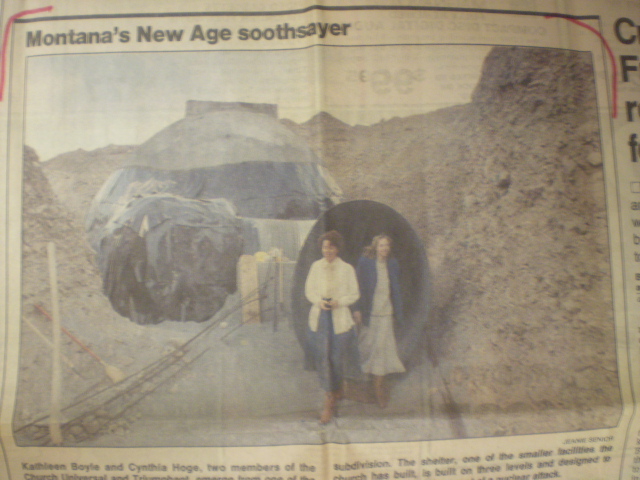
Ralph and Roberta Winter were given the option to buy the campus they purchased in Pasadena, California in the late 1970s for the World Mission Center they planned to establish after God gave them the victory following many prayers against a cult that occupied the campus then and also wanted to buy it.  They were known as the Church Universal and Triumphant.  Roberta received a mailing containing a newspaper clipping from friends of hers in Newberg, Oregon giving her an update about this cult on December 10, 1989.

It is “The Oregonian” newspaper.  The title of the article is “Church leader fans fires of fear” and the subtitle reads “Predictions of a New Year’s Eve nuclear attack, stockpiling of guns and environmental issues stir public concern.”  In Gardiner, Montana, Elizabeth Clare Prophet’s followers know her as Guru Ma or Mother.  She is slender and youthful at 50 with brownish hair.  She likes jewelry studded with large gems.  The rest of the descriptions of her put her squarely in the suburban yuppie group.  Her follows regard her as a messenger who brings divine revelations, and for several months the revelations have been about nuclear war, which Prophet believes is imminent.

Fear of nuclear war is a main reason she moved the world headquarters of her Church Universal and Triumphant to Montana from California in 1986.  Several hundred church members followed their leader and also moved.  “Prophet, who passes on what she calls ‘dictations’ from a flock of ‘ascended masters’ that include mystics and saints, informed her followers in October that an ascended master called El Morya had delivered an update: ‘If I were you, I would see to it that my preparations were complete by New Year’s Eve.’”  Prophet specifies that the Soviets may launch a nuclear attack on the United States on New Year’s Eve.  Heeding her warning, church members are preparing for Armageddon by storing dehydrated food and constructing a vast complex of bomb shelters in southwestern Montana’s Paradise Valley, with its magnificent blue sky, rugged mountains and high plains that end at the northern boundary of Yellowstone National Park.

Nonetheless, church watchers fear they are also stockpiling weapons, ammunition and other paramilitary gear.  This church believes in a combination of survivalism and theology with New Age teachings, Christian and Eastern beliefs and political conservatism.  Local residents, environmentalists and staff at Yellowstone National Park have felt uneasy about the sect since 1981, when the church paid about $7.1 million for a 13,000-acre ranch.  The church’s holdings have since expanded to more than 33,000 acres, which means the Church Universal and Triumphant’s Royal Teton Ranch is the second largest private landholding in Park County, Montana.
OLYMPUS DIGITAL CAMERA

A Letter From Dear Mother

On August 27, 1953, Hazel Patterson Winter typed a letter to her son and daughter-in-law, Ralph and Roberta Winter. Dr. Winter has just graduated from Cornell University in New York with his PhD and is going to visit his parents in South Pasadena, California before heading back to the East Coast to attend Princeton Theological Seminary in New Jersey in the fall. Hazel Winter starts her letter by saying it was good to receive Ralph’s letter the day before and Roberta’s on this day. A check for them is enclosed which they are most welcome to use. In case they need more, one of Ralph’s bonds is also enclosed. Daddy [Ralph’s father] conveys that it is worth $94.00 now, so Ralph will not lose much if he does need to cash it. He still has nine of the $25.00 ones and all are very close to the maturity date. Ralph can check on them when he arrives.

Ralph’s parents are so eager to know how everything is and they trust that they will see him and Roberta in good time. However, his mother cautions them to please not try to drive through without adequate sleep or to make too fast time. She writes, “Of course I know you aren’t children and that you have driven across the country before, Ralph, but it still is dangerous to drive when you are too tired or too sleepy.” She believes it is hard to sleep on a bus and expects it would be just as bad or worse to sleep in the back of a car. His parents will be praying for them every step of the journey, “not only that God will wonderfully care for you but that you will use good judgment.” In preparation for their arrival, Daddy has washed the windows in their bedroom two or three times, and each time he commented about Ralph and Roberta being here soon. The drapes have been cleaned and Mother has washed the bedspread and cleaned the closet as much as she can. “There is so much in there that it is a little difficult to make it look just right. I have tried to dust your books but haven’t done it enough I guess because they are dusty.” Hazel thinks they should have tacked light curtains over the front of the boxes so the books would have been better protected.

Mother next asks Ralph about the clinic he is going to because she is concerned about his headaches. Charles Brooks questions whether they are migraines but she trusts not. She does not believe migraine headaches are related to pressure about the neck, which is what always made Ralph’s headaches worse. She should be grateful if he sees a good doctor, which would be worthwhile even if they arrive a week late to Mother and Daddy’s house. She acknowledges, of course, that he must make a decision there and she is confident he will know what is best.

Mother and Daddy received a letter from Ralph’s brother and sister-in-law, Paul and Betty, today too. They went on a little trip a week ago with their children and the Cudneys. Hazel has thought of them and trusts that they are having a good time and resting. In the September issue of “National Geographic” magazine there is a fine article about an American family in Afghanistan written by one of the Habibia teachers’ wives. It has large pictures of the very territory where [Paul and Betty] are going, so it was very interesting to Mother and Daddy. “Last night we took it up so the Brooks could see it. They are going on a little vacation to the High Sierras and will return it when they come back.” Daddy has walked in and since it is almost five o’clock, they must go register this letter sent with all of Mother’s sweetest love.

OLYMPUS DIGITAL CAMERA

Be Motivated By Dr. Winter!

Dr. Ralph Winter was featured as a seminar speaker in a bulletin of the Greater Los Angeles Sunday School Association in September of 1992. The bulletin is titled “Glass Window” with the subtitle “Serving the Needs of Today’s Christian Educators.” He is speaking for their Glass Convention to be held in November. His biographical write up states that he is giving an intensive seminar on missions and that he is the director of the U.S. Center for World Mission. He was born and raised in California and in his young years was involved in Christian Endeavor, Youth for Christ, and the Navigators. He graduated with a Bachelor of Science in Civil Engineering from Caltech and taught at Westmont College for one year. “His interest and concern for the world grew and after attending the first ‘Urbana,’ he helped organize a pioneer effort to Afghanistan.” His other degrees are a Master of Arts in Teaching English as a Second Language from Columbia University, a PhD in Structural Linguistics from Cornell University and a Bachelor of Divinity from Princeton Theological Seminary. He was ordained as a Presbyterian minister and served in Guatemala as a missionary for ten years and as a professor at Fuller Seminary’s School of World Mission for another ten years.

The column goes on to mention that “[Winter] has written extensively and has contributed regularly to a number of Christian magazines such as Moody Monthly, Evangelical Missions Quarterly, Eternity and Christianity Today.” Among his publications are Theological Education by Extension and Perspectives on the World Christian Movement. This intensive seminar will be about the missions crisis in the local church, what the task is that remains for missions, and practical ways of creating mission vision in the local church. Jesus commands us in the Great Commission to “Go and make disciples of all nations” but are we as believers truly faithfully following the Lord’s last command? The piece concludes by saying that attendees will be greatly inspired in this seminar as they hear about the challenge of missions from a different perspective.

Winter portrait4.

Missionary Reflections in Guatemala

On July 1, 1959 Ralph Winter got together with this friends Dale Green and Bruce Macadam to have what they call “Missionary Discussions” in Guatemala, taking notes as they chatted. They begin by addressing the meaning of salvation, which they agree is reconciliation and health for the individual and the family and physical needs being met, specifically food and economic. They list six points under stability and prosperity for the community and/or family.

  1. Christians helping other Christians.
  2. Christians in states and Guatemalan Christians benefitting each other.
  3. Paul’s missionary journeys involved taking up a collection for the poor saints in Jerusalem.
  4. “The hand cannot say to the foot, I have no need of thee.”
  5. Christians in states can help “native Christians” to prosper whereas the natives can help stateside people in spiritual matters.
  6. If Winter and his friends concern themselves with the full salvation of the Christians now existing, the initial stage of salvation is mostly taken care of by those Christians. In the United States, this is noticeable when the pastor “feeds” his people. “In the more economically backward areas, it also takes the form of the pastor feeding his people only in a more literal sense.”

The men go on to say that in the present times, the Great Commission has much less geographic significance and more of a mission in depth approach. There are few people currently who are not within the evangelistic territory of some church except in areas where organizations like Wycliffe work. Yet most of Wycliffe’s work is within areas that have churches. The Great Commission is to go, teach, make disciples and baptize. “Teach means teaching in every area besides Biblical truths. The Great Commission is not fully fulfilled when a person just becomes a believer.” In lands outside of the U.S.A., the church is to operate in a community sense, meaning it must carry the burden of all phases of life.


What Should TEE Students Read?

Dr. Ralph Winter wrote a memorandum to his colleague Fred Holland at Fuller Theological Seminary on September 13, 1976. He begins by saying he is sure Holland remembers George Patterson along with his constantly active efforts in Theological Education by Extension (TEE). He writes, “[His] booklet should be entitled “Rethinking Theological Education” and I have communicated the same to the people who publish it in Portland.”

Meanwhile, Winter believes the booklet would be of great value in the TEE courses at Fuller as one of the texts professors have the students read. He asks Holland what he thinks. Winter assumes this will be of value to them and so he has ordered 100 copies. If by any chance this is not of interest to Holland, Winter and others will simply sell the booklets through the Book Club. Otherwise, they are or will be available in the fall. Winter asks Holland to tell him what he thinks. Holland’s handwritten reply on the same memo mentions that they MUST get Winter’s TEE original textbook reprinted and because Holland’s own book, Teaching Through TEE, is practical rather than theory based, Holland welcomes the Patterson booklet that Winter is proposing be used.


How Will The Faculty Fellowship?

The Faculty Fellowship Committee of Fuller Theological Seminary met on November 9, 1972 and Dr. Ralph Winter was present at this meeting, according to the minutes. They say that the committee talked about the Monday morning faculty prayer meeting and decided to keep the regular prayer meeting as it is being conducted currently. “However, on the basis of faculty expressions at the retreat in September, it has been suggested that the faculty be surveyed regarding interest in small groups whose purpose would be to allow for the expression of intimate concerns and related prayer.” No one took action on the matter of the survey.

Another discussion was about the quarterly faculty dinners. The committee decided that the faculty dinner coming up that includes a special guest should not substitute for one of the three regularly scheduled faculty dinners. Committee members considered various faculty presentations, and decided that one of them will approach three faculty members to ask about their willingness to present ideas for discussion at the Faculty Fellowship dinners. The first is President Hubbard, and the options for topics are the Wisdom Literature, his philosophy as seminary president, and Genesis chapters 1 and 2. The second is a gentleman who may speak generally if willing about his interest and concerns regarding Women’s Liberation. Thirdly, a gentleman will be invited to present his interest in the Male-Female writings which he recently completed. The committee agreed to hold the three faculty dinners of the year on Monday night of finals week for each of the three quarters. The first dinner, hence, will be on December 4, 1972. The minutes were submitted by a substitute committee member serving as the substitute secretary.

old-man-praying

Dr. Winter’s Interest in Science

Dr. Ralph Winter submitted and presented a paper at the annual meeting of the American Scientific Affiliation in early August of 2002. The theme of the meeting is “Christian Pioneers in Science.” The plenary speakers are a professor of nuclear engineering at Massachusetts Institute of Technology and a professor of physics at the University of California in Berkeley. In the Call for Papers that the program chairs send out, they write, “We welcome contributed papers and poster presentations on all topics related to Science and Christianity, though special consideration will be given to historical papers dealing substantively with important Christian scientists from the past.” Emphasis will be given as well to symposia and panels that the commissioners organize and to papers and posters which young scientists, graduate students, and advance undergraduate students submit, with the hope of encouraging future Christian pioneers in science. They go on to say that papers ought to be based on work in one’s area of expertise, and where this is not obvious, presenters may be asked to show suitable documentation. This Call for Papers is designed to be copied and widely posted; presenters in addition to planning their own participation are urged to personally invite non-members and students to submit proposals and to attend.

Under the “Requirements and Guidelines for Abstracts,” one bullet point states that abstracts should emphasize the new and important parts of a presentation and include as much detail of the work as possible within the limit of 250 words. The abstract and presentation must be intelligible and clear to non-specialists. Authors are permitted to present only one paper, though they may be one of multiple authors on a paper. “Limitations on program space may require some individuals submitting requests for an oral paper to present posters; the chairs will notify such persons as soon as possible.” Oral papers that are contributed will be allotted a time of 20 minutes with 5 more minutes for discussion. A separate time and space is for poster presentations. Authors of poster exhibits will have detailed instructions given to them upon their abstracts being accepted.


The Winter Definition of Faith

These posts will be shorter while we are in search for a way to scan and upload the archives documents themselves to a website to which readers will have access. The documents will be in searchable PDF files. Please pray for us to be in this position soon! I will keep you informed.

On Friday, December 7th in 1984 at 6:50 in the morning, Dr. Ralph Winter typed a write-up which he begins by stating that some years before, it seemed as though God gradually and insistently loaded down him and Roberta (his wife) with an awareness of a need that was great and urgent. For them at the time, the “obedience of faith” meant attempting to do what they could humanly see to be possible only remotely. But the risk is outweighed by the potential value. “The faith God gave us, which was sufficient to obey was in effect the conviction that what ought to be could be attempted without fear of the consequences.” Generally, what Winter is saying is that often, faith is simply the conviction that what ought to be must be pursued whatever the risks are. Therefore, faith is the conviction that what ought to be should be worked for without any human certainty of success. This is close to what their daughter Becky once said, which is that “faith is not the conviction that God will do what you want Him to do but the confidence that you can do what [He] wants done and leave the consequences with Him.”

RDW and Roberta

Dr. Winter’s Graduate School Days

Dr. Ralph Winter typed a letter on a typewriter to his parents and younger brother David in May of 1953, while he was a Doctoral student at Cornell University. He says to start that a few minutes ago, no he guesses about one hour ago, his advisor stopped by with the rest of his thesis. The advisor’s point of view, which Winter believes justified, is that he wants this thesis in good shape and written clearly. Winter does not blame him; the advisor is in no hurry. It is a work in progress which merits carefulness. Winter confesses it is not right for him to be zealous about arriving at home in record time, meaning that he speeds through the job in not quite a polished form. His advisor is more realistic than Winter about proportions of the job of refining the written work. Winter states, “In my experience I have rarely had time to revise things, and such a process is not familiar to me nor something which I naturally do. Most of my writing is like what I am doing now. If something is not plain I clear it up in the next sentence.” The skill of reviewing something with the aim of re-expressing it to a greater advantage is not a skill Winter has fully developed in his experience, to say the least.

His advisor feels as though Winter writes well when he writes carefully. However, the second half of his thesis is not at all polished but rather what Winter sat down to write. It is true that the second half is not the ticklish sort of writing that is found in the first half, but in moving from the first half of the thesis into the second half, the advisor discovers numerous necessary modifications of phrasing throughout. So after spending most of a day reading it and likely feeling pressed for time at the point where he is having to mark points of style more and more, about 20 pages into it he brings it to Winter with a handwritten note on the front asking Winter to go over it with care again. He is to give up on rushing because the advisor will accept and approve nothing less than his best job.

What all this means is that Winter will not have his final oral exam before the next week, when his anthro advisor will be gone, which is all right but he thinks this professor would have been easier on him than one of the other men who may substitute in his final oral. “But the one good thing is that while my Math advisor will be leaving for a week, he is certainly coming back; if he were to leave I am sure I would give up trying to pass an oral with a minor in Math.” Winter laments that under the circumstances, his final oral exam will not be before June 10th and he is very sorry this will cause him to be back home later. His time with his brother David before he leaves will be even shorter, for which he apologizes.

Winter is eager to submit a finished piece of work and hates that he has rushed through the thesis, which conflicts with his tendency to be perfectionistic. Even so, he mentions that it is too bad his advisor desires for his writing style to be just like his. Winter will need to write it and make changes again, then turn it in for a final check before the very last typing. The Winters guess they will extend their $5 typewriter for another week or two. At least it will produce a larger-type, clearer copy for the advisor to read. Winter thinks that “part of the psychology of his revisions is involved in the appearance of the page—if there have been some changes on a page already, he is all the more inclined to treat the page like a non-final copy.” So if all the pages are retyped, more readable and clear, Winter hopes this means they will be less needy of revision.

Cornell Univ.

Dr. Winter’s Top Priority

Dr. Ralph Winter, General Director of the Frontier Mission Fellowship, wrote a short essay on Saturday, the 12th of June in 1999 with the title “The Most Important Thing” and the subtitle “A rationale for daily inspiration.” He begins with the heading “The Battle for the Bible: Advice to Myself.” He says there really is a battle going on, and the Enemy of our souls considers it the greatest battle for our soul regarding the fact that the Bible keeps us from sin and sin keeps us from the Bible. The battle is emotional as well as spiritual. If we lack an appetite for the Word of God, any small excuse can divert us. Winter writes, “If we look forward with anticipation and excitement we are much more likely to seek and to find God’s Word to us.” So it is a choice we have to set our affections on things above rather than on things on the earth. The Bible calls us to choose to delight in God and God’s will. Paul means “Rejoice in the Lord” as a command and goes on to say that things worthy of us thinking on and dwelling upon are true, honorable, right, pure, lovely, of good repute, excellent and worthy of praise. These are commands too. Philippians 4 assures us that commands are accompanied by the marvelous promise that to practice them leads to the God of peace being with us.

Therefore, Dr. Winter states that even before we get out of bed each day, we should:

  • Deliberately focus our groggy minds on the Bible
  • Try to remember what we learned from the Bible the previous day
  • Reflect on what new insights may be acquired today
  • Hang on for dear life!
  • Do the minimum amount of dressing and stirring around before opening our Bibles

Of course we must brush our teeth, maybe check the newspaper headlines. But paying attention to a news broadcast is less of a priority to Winter than walking into the day with God and the things of Him uppermost in our minds. What if we go to bed late one night? Follow Plan B since we take time away from the morning if it is used up the night before. Maybe it is carelessness or even a demonic diversion, Winter mentions, so we should repent of it and get on with the day. We can focus our hearts on God even without brand new input from the Bible. We are to be sure to recall the high point of the day before and ask for God’s forgiveness. Winter encourages, “Hang on to Him and to the God-conscious life He has asked you to live.”

The next heading is “The Battle for the Bible: Advice to Others.” HOW do we read the Bible? Only reading may not suffice. Chewing and inwardly digesting is important. Most important is for God to deposit some new, fresh thought into our minds and hearts. After all, the Bible assures that His mercies are new every morning. So Winter asks that we not let thoughts God gives to us escape but to jot them down and journal with determination. Studying the Bible may not be good enough either. Study accompanied by spiritual reflection is preferable. The Bible is not a book that is magical and pops truth into our minds without us seriously studying it. Winter supports the Inductive Bible Study approach and calls it valuable. He also differentiates a time for study and a time for spiritual refreshment and says some of both each day is good. A plan is good, moreover, unless it becomes our master. Jesus said the Sabbath is for man and not man for the Sabbath. “Satan would love to tie us up in knots by giving us arbitrary ‘goals’ of athletic-like Bible-reading achievement. Something we can boast about.”

Winter suggests we not go at it alone because everyone benefits from encouragement and accountability. It can be so helpful if we share our aspirations with another person who is willing to check on us. If we eagerly hear from God, we will eagerly share what we hear. All that God speaks to us, whether by way of admonition, solace, or inspiration, is worth sharing with others. Winter cautions, however, about the snare of the teacher or preacher. Some may go to the Bible simply because they are desperate for something to share to impress others. Winter identifies this as a snare and continues, “In that case we are not seeking God in that quiet desperation but seeking to save ourselves embarrassment or failure.” He concludes by reminding us that walking with God is a high aspiration that is rewarding and strengthening. Over time we learn more how to approach it exactly. Practicing God’s presence takes practice but it is worthwhile. In the course of our lives, it indeed may be “the most important thing.”

Word of God